
Source: compiled from Xinhua (“French supermarket refrigeration systems hit by cyberattack”), BleepingComputer (“Cyberattack shuts down refrigerators at French supermarkets”) and The Hacker News (“Attackers Heat French Supermarket Fridges Up to 50°C by Hijacking Danfoss Controllers”). Original reports: Xinhua · BleepingComputer · The Hacker News
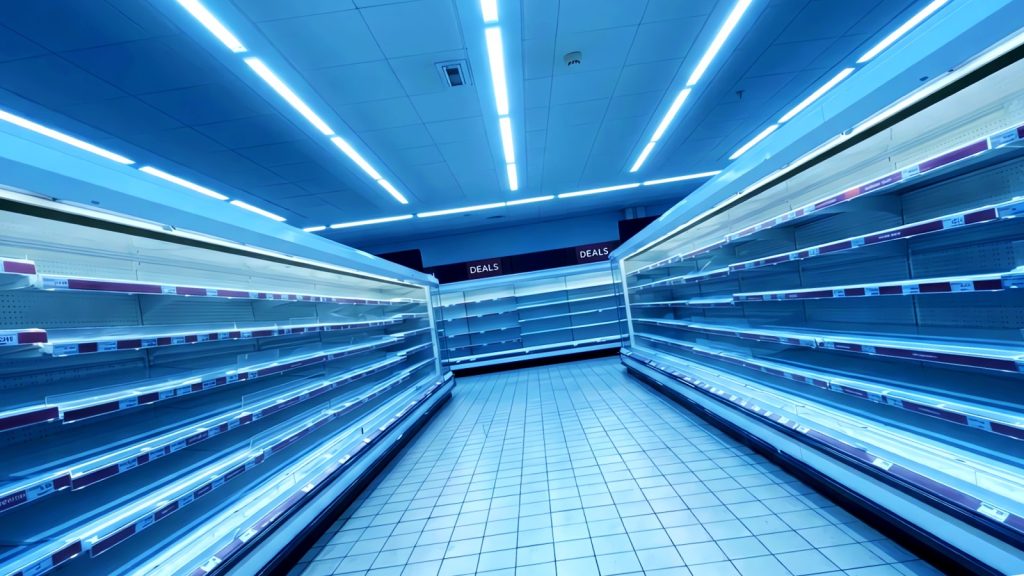
Late on 11 October, the refrigeration systems of hundreds of French supermarkets were taken over remotely. The attackers did not touch the tills and did not steal data — they turned the fridges up. Set points were pushed to 50 °C, and shelves of fresh and frozen food had to be thrown away.
According to Xinhua, which cites a French broadcaster, the stores affected belong mainly to large chains such as Intermarché and Coopérative U, and independent shops — butchers in particular — may also be involved. French media put the number of affected stores at 250 to 350, with nationwide losses possibly reaching several million euros.
How it worked: the defrost function, turned against the fridge
BleepingComputer reports that the attackers got in through the controller that runs a store’s refrigeration — the unit made by Danish manufacturer Danfoss that maintenance firms use to manage the system remotely. Those controllers were running older versions of Danfoss software.
Refrigeration equipment defrosts itself on a schedule: frost builds up, cooling efficiency drops, so the unit clears it. The attackers used exactly that. They forced the equipment to keep defrosting and moved the set point to 50 °C, so cabinets that should stay below zero kept getting warmer. In effect, the equipment was turned against the very thing it exists to protect.
Reactions: unusually strong wording
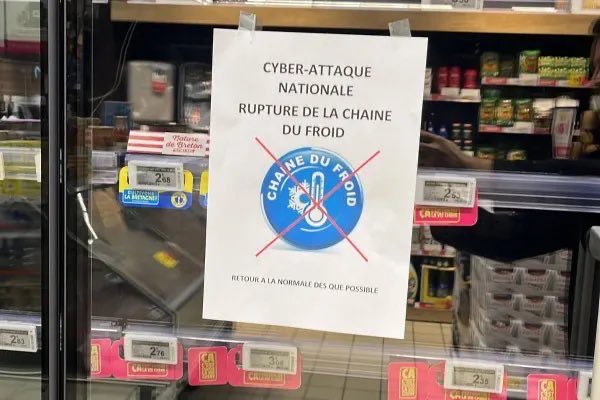
An Intermarché spokesperson told BleepingComputer that “following a cyberattack reportedly affecting a service provider that manages refrigeration systems in stores, some fresh and frozen food display units are out of service”, adding that Intermarché and Netto had removed products from those units as quickly as possible.
Coopérative U president Dominique Schelcher confirmed the attack on X: “Targeting equipment essential for preserving fresh produce and supplying food to the French people is an extremely serious matter and is unprecedented. It is unacceptable.” EU agriculture and food commissioner Christophe Hansen also condemned the attack and named France’s largest supermarket chain, Leclerc, among the victims.
AFP reports that the Paris prosecutor’s office has opened an investigation into the “large-scale cyberattack affecting the refrigerators of several major food retail chains across France”, in order to identify the victims and establish the link with the food losses the chains reported and with the outbreak of fires at some stores. France’s national cybersecurity agency, ANSSI, has confirmed a vulnerability in Danfoss software, contacted the vendor and is coordinating with European counterparts while checking other companies that may be affected.
The vulnerability is not new
The US Cybersecurity and Infrastructure Security Agency (CISA) warned about the Danfoss AK-SM 8xxA hardware platform in May 2025 (authentication bypass, CVE-2025-41450) and again in August 2025 (command injection, CVE-2025-41451) — the very platform used to manage refrigeration and HVAC systems in food retail. Claroty’s Team82, which found both flaws, published details in August on how to achieve remote code execution on a Danfoss AK-SM 800A through its publicly accessible management interface.
How large is the exposure? Security researcher Baptiste Robert found 2,752 Danfoss systems reachable online on the Monday after the attack, 1,590 of them in France, while the device search engine Shodan tracks more than 4,500 internet-facing Danfoss devices.
What it means for the HVAC and refrigeration industry
This is closer to our industry than it looks. Refrigeration controllers, building management systems, plant-room controls — anything that can be logged into remotely — work the same way as HVAC equipment: for convenience, the management port is often left facing the public internet. That convenience and that exposure are two sides of the same decision.
Equipment safety used to be about whether a fire damper closes reliably at high temperature, or whether a fan keeps running in a damp environment. Now there is a second question: once the equipment is online, who can log into it, and which parameters can they change? Here, only a temperature set point was changed — and the cost was a store’s worth of food and millions of euros.
Six things you can do now
- Do not leave controllers facing the public internet: reach them over a VPN or an IP allow-list, and close the management port to the outside.
- Replace default credentials and give each maintenance engineer their own account, revoked when they leave.
- Update the firmware: patches for the two flaws involved here (CVE-2025-41450, CVE-2025-41451) have been published by the vendor.
- Separate the equipment network from the office network, so a compromised PC cannot reach the refrigeration controller.
- Alarm the important parameters: if a set point or a defrost mode changes, someone on duty should know immediately.
- Keep a manual fallback: temperature logs and an emergency transfer plan, so the first priority on site is saving the stock, not finding the cause.
For anyone who builds, installs or maintains this equipment, the lesson is concrete: the convenience of being online and the control that comes with it are the same thing. Whether a controller’s parameters can be changed remotely depends on which network we put it in on day one.
YAQIVENT’s view
The French case is a reminder for HVAC: networked refrigeration controllers, building automation and remote-monitoring platforms are now attack surfaces. Default passwords, unencrypted remote channels and firmware that is never updated are all open doors.
Manufacturers should treat security as part of the product: force a password change at commissioning, close unneeded remote ports, provide firmware updates and access logs, and define responsibility in the contract. Buyers should write cyber-security clauses into tender requirements.
Source: Xinhua (Xinhua News Agency, Paris, 12 October), BleepingComputer and The Hacker News. This article is an industry summary; the facts and figures are quoted from those reports and the views are for reference.