
Source: Tencent News / Guancha, “Heating oil up 74.9% — Europeans are queueing to buy Chinese heat pumps” (19 October 2026) — news.qq.com/rain/a/20261019A0E1XA00
Europe’s heating season has only just begun, yet a German HVAC forum already has a buyer fretting over a Chinese heat pump: the model he wants is quoted at €4,999 but cannot be delivered, and the Swiss channel would not ship until February 2027.
On HaustechnikDialog, a long-running German HVAC forum, the poster explained that his old heating system had not survived the summer shutdown and needed replacing urgently. The unit he had settled on was Midea’s H-Pack.
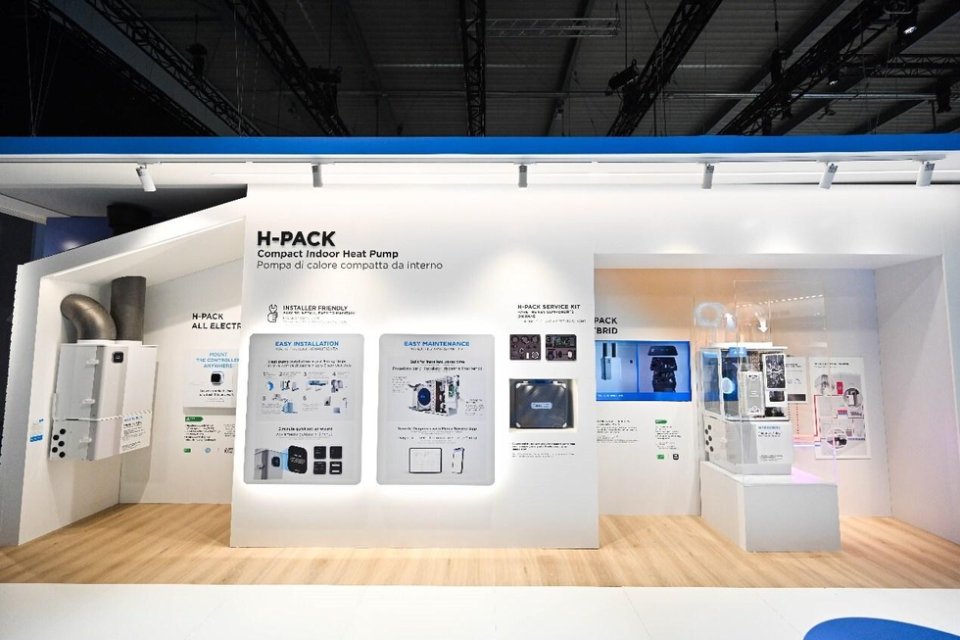
H-Pack is Midea’s answer to Europe’s retrofit problem. Instead of an outdoor unit, the main equipment sits indoors and exchanges heat through ducts in the wall or roof. It can also be plumbed into the existing system and run alongside a gas boiler — adding a heat source without tearing out radiators that have been in place for decades.
Similar choices are already being made. In early October a German homeowner switched a 1956 house to heating from a Hisense air conditioner: eight rooms now hold 20–22 °C year-round, the old gas boiler stays on for hot water, and equipment plus installation came to about €7,000 after subsidies — with a first-season efficiency ratio he estimates at above 4.
From selling air conditioners to retrofitting what is already there
Chillventa 2026, the biennial refrigeration and HVAC trade fair, ran in Germany from 13 to 15 October. Chinese exhibitors numbered 184, up 38% on the previous edition — behind only Germany (273) and Italy (201). German media described it as competition from the Far East intensifying.
After Chinese air conditioners sold strongly across Europe this summer, Midea, Hisense and Haier are now chasing heating retrofit orders, going head to head with incumbents such as Daikin and Bosch.
Europe’s heating bill is being recalculated
Europe is not short of heating. Germany’s 2022 census found that about 56% of homes are heated with gas and 19% with oil — three quarters of the housing stock. That system worked reliably for decades; today it is the risk line on the bill.
The price shock is direct: gas for new customers in Germany is up 55% this year, from 8 to 12.4 cents per kWh, and storage is expected to sit at just 75–78% in early November, about 10 points below the five-year average. Heating oil has moved further still — up 74.9% year on year in September — while the International Energy Agency has warned that global diesel tightness could last into 2027.
Hence the turn to heat pumps. Instead of turning electricity into heat through a resistor, a heat pump moves heat from the outside air indoors with a compressor; when conditions suit, one kilowatt-hour of electricity yields three or more of heat. In the first half of 2026 German heat pump sales reached 194,500 units, up 40% year on year and, for the first time, ahead of the 134,000 gas-fired heating units sold over the same period.
The real bottleneck is installation
Upfront cost is the obstacle. Older houses need a heat-load calculation and a check that the existing radiators can deliver enough heat at lower water temperatures; some projects also need new emitters, re-piped circuits and extra insulation. Siting the outdoor unit brings noise, boundary-distance, façade and permitting issues of its own.
That leaves European households in a bind: keep burning oil and gas and watch the bills climb, or replace the whole system and find the capital. The gap between those two options is where Chinese manufacturers see an opening.
Three answers from Chinese manufacturers
The first is to remove less. Midea’s H-Pack puts the main unit indoors and runs it in parallel with the old boiler, with controls that compare the running cost of each heat source and pick the cheaper one. The second is to run hotter: TCL’s R290 Tri-thermal for Europe reaches a flow temperature of 80 °C (75 °C without the backup electric heater), and some Haier commercial air-to-water units also deliver 80 °C, improving compatibility with existing radiators.
The third is to build the channel. In Europe the installer usually decides which brand goes in. In February Gree cut the installer price of a 10 kW monobloc in Poland to 10,000 złoty (about €2,300 excluding tax and labour), having earlier offered compliant installers a 1,000 złoty commissioning bonus along with selection tools and a dedicated purchasing channel.
The results show up in the export numbers. Chinese air-source heat pump exports reached RMB 5.83 billion in the first half of 2026, up 41%, while domestic sales fell 4.8%. Exports of related products to the EU came to $487 million in January–April, up 60.4%, with Germany, Spain and the Netherlands leading the growth.
“Made in Europe” pushes back
On 13 October Stiebel Eltron, one of Germany’s established heating manufacturers, issued a statement bluntly titled “China is seizing the German heat pump market”, with chief executive Kai Schiefelbein calling for European industrial policy. Yet an April survey by the European Heat Pump Association found that, in a sample covering about 70% of European air-to-water heat pump sales, 80–90% of monobloc units are still assembled in Europe and only 5–10% in China.
Policy is tightening regardless. From 1 September France requires equipment qualifying for the “Coup de pouce Chauffage” heat pump bonus to hold French-approved certification and to have completed specified assembly steps in the European Economic Area; on 1 October it added a one-stop scheme for lower-income households that explicitly requires French or European-made air-to-water heat pumps. The European Commission’s Industrial Accelerator Act, proposed in March, would impose EU origin requirements on water-based heat pumps three years after entry into force — the bill has yet to complete the legislative process.
Chinese firms are adapting. Midea took control of the Italian HVAC maker Clivet in 2016, and in September its new heat pump plant in Feltre came on stream — €24 million invested, 8,800 units a year at full capacity. Haier bought the Hungarian distributor KLIMA KFT in June last year, and Zhuhai Sanyou plans a joint venture with European partners alongside acquisitions of local channels.
The German homeowner is still waiting for his unit. He does not want to rip out the old boiler; he wants to get through the winter for less. That, perhaps, is what unsettles Europe’s incumbents most: Chinese manufacturers looked at what European households actually need — and looked earlier.
YAQIVENT’s view
The core of European demand is not “replace the system” but “replace less”: hybrid heating, indoor units and 80 °C flow temperatures all accommodate the boiler and radiators already in place. Whoever makes the retrofit lighter wins the order.
The second thread is localisation. French subsidies and the EU Industrial Accelerator Act are writing “made in Europe” into the rules, which will narrow the space for exporting complete units; building European assembly, channels and installer incentives early is cheaper than reacting later.
Source: Tencent News, republishing an exclusive report by Guancha (news.qq.com/rain/a/20261019A0E1XA00). This article is an industry summary; the data is quoted from the original report and the views are for reference.