
Source: Sohu News, “US heat pumps take 58% of heating shipments; the record is matched despite subsidy step-down; the 2027 heat pump expo to map certification and channel paths for Chinese exporters” — news.sohu.com/a/1085609179_241046
In the first half of 2026, heat pumps rose to 58% of US heating equipment shipments, matching the all-time record set in 2024. The result is all the more notable because it came while the federal 25C tax credit was stepping down and several states were tightening their own rebates.
Shipment statistics published by the Air-Conditioning, Heating, and Refrigeration Institute (AHRI) in July 2026 put US heat pump shipments at roughly 2.18 million units in the first half, down 1.2% year on year. The wider heating equipment market contracted faster, however, so the heat pump share climbed from 54% a year earlier to 58%.
Demand has shifted from policy to replacement
The first layer of support is the replacement cycle. Around 60 million gas furnaces remain in the US housing stock, with an average service life of 15 to 20 years. A residential energy consumption survey published by the US Energy Information Administration (EIA) in April 2026 found that roughly 12 million furnaces came due for replacement between 2020 and 2025 — and those owners are weighing a new furnace against a heat pump now.
The second layer is running cost. EIA data from June 2026 show residential electricity prices up 4.8% year on year, while residential gas prices rose just 1.1%. But with heat pump coefficients of performance (COP) generally above 3.0, the cost per unit of heat delivered remains 20-35% lower than with a gas furnace — a calculation owners in the Midwest and Northeast are making closely.
The subsidy step-down mainly affected marginal demand. Once the federal 25C credit was reduced, the tax benefit per unit fell from as much as $2,000 to around $1,200, and some states tightened rebates in parallel. AHRI’s July 2026 analysis attributes the dip largely to demand pulled forward into March and April; the shipment curve stabilised quickly from May onwards.
Policy takes over: state codes and utility programmes
What is really holding shipments up is a combination of state building energy codes and utility demand-response programmes. Statistics from the Building Codes Assistance Project (BCAP) in May 2026 show that 14 states have adopted the 2024 IECC energy code, and nine of them set hard efficiency thresholds for space heating equipment — thresholds gas furnaces struggle to meet, which makes heat pumps the default choice.
Utilities are adding momentum of their own. A March 2026 report by the American Council for an Energy-Efficient Economy (ACEEE) found that more than 80 US utilities now run heat pump incentive programmes, including bill rebates, low-interest loans and time-of-use tariffs. Because these are funded from utility rate bases rather than the federal budget, they are considerably more stable than tax credits.
What it means for exporters
For Chinese exporters, the shift in market structure leads to a straightforward conclusion: competition is no longer about price but about certification timelines and after-sales networks. In North America, UL and AHRI certification typically needs to start nine to twelve months ahead, while the after-sales network determines whether project clients keep placing orders.
The EU and Southeast Asia: two different playbooks
The European Union is a standards-driven market. The European Commission’s May 2026 REPowerEU progress report puts the EU’s cumulative heat pump target at 50 million units by 2030, against roughly 22 million installed so far. A EUR 1 billion auction for decarbonising industrial process heat, launched in 2026, is further driving demand for high-temperature heat pumps. Local requirements on energy labels, the F-Gas regulation and ecodesign rules are strict, however, and certification costs run higher than in North America.
Southeast Asia is more cost-driven. Commercial hot water and agricultural drying demand is growing quickly in Vietnam, Thailand and Indonesia, but price sensitivity is higher and certification barriers are lower. Data from China’s General Administration of Customs (August 2026) show first-half heat pump export value to ASEAN up 23.7% year on year, ahead of North America at 6.2% and the EU at 11.4%.
March 2027: where certification, buyers and after-sales converge
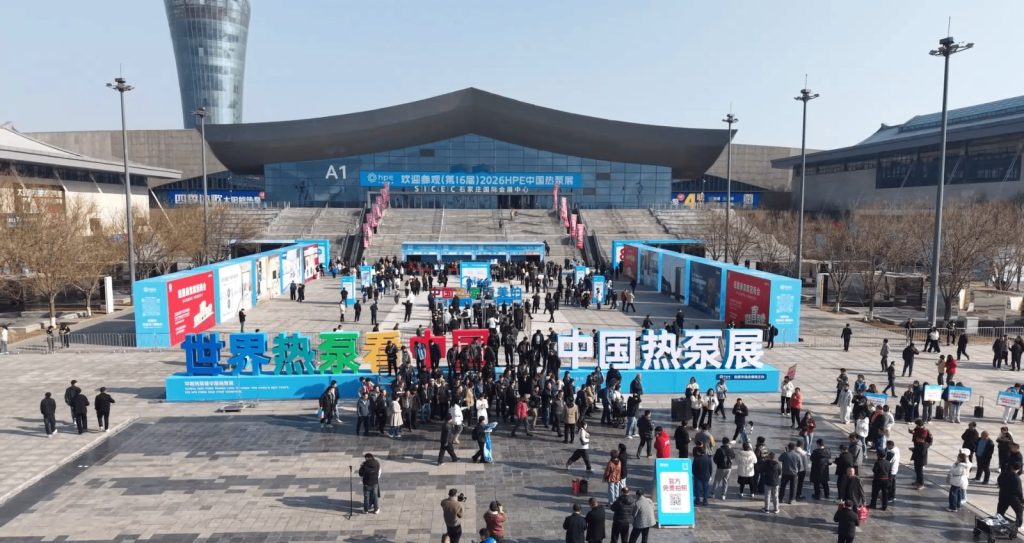
These themes will come together at the 17th HPE China Heat Pump, Hot Water, Heating, Comfort, Drying and Industrial Application Expo, to be held from 15 to 17 March 2027 at the Shijiazhuang International Convention and Exhibition Center. The show will use eight halls, E1 to E8, covering around 75,000 square metres, and is expected to gather more than 900 exhibitors from across the supply chain and upwards of 110,000 trade buyers, with dedicated zones for plumbing, pumps and valves and for export certification support. For reference, the 2026 edition spanned 35,000 square metres and drew 115,000 trade visitors, 72.8% of them B2B buyers with purchasing authority.
Putting it together, an export plan for 2027 might look like this: map certification routes and start UL/AHRI sampling in the fourth quarter of 2026; lock in overseas buyer lists and prepare English technical documentation in the first quarter of 2027; meet buyers, show samples and sit down with certification bodies at the March show; follow up on sampling tests and sign after-sales agreements in the second quarter; and push into Southeast Asian and Middle Eastern channels in the second half of the year.
YAQIVENT’s view
The US market carries a clear lesson for Chinese heat pump makers: a subsidy step-down is not a demand cliff. The replacement cycle for gas furnaces, state energy codes and utility incentives are moving demand from “policy-driven” to “replacement- and code-driven” — steadier, and far more dependent on delivery capability.
For exporters the real barrier is not price but UL/AHRI certification timelines and the after-sales network. Start certification at the quotation stage and put spares, training and response times into the contract; North American buyers pay a high price to switch suppliers, so once you are in, you tend to stay.
Source: Sohu News (news.sohu.com/a/1085609179_241046). This article is an industry summary; the data is quoted from the original report and the views are for reference.