
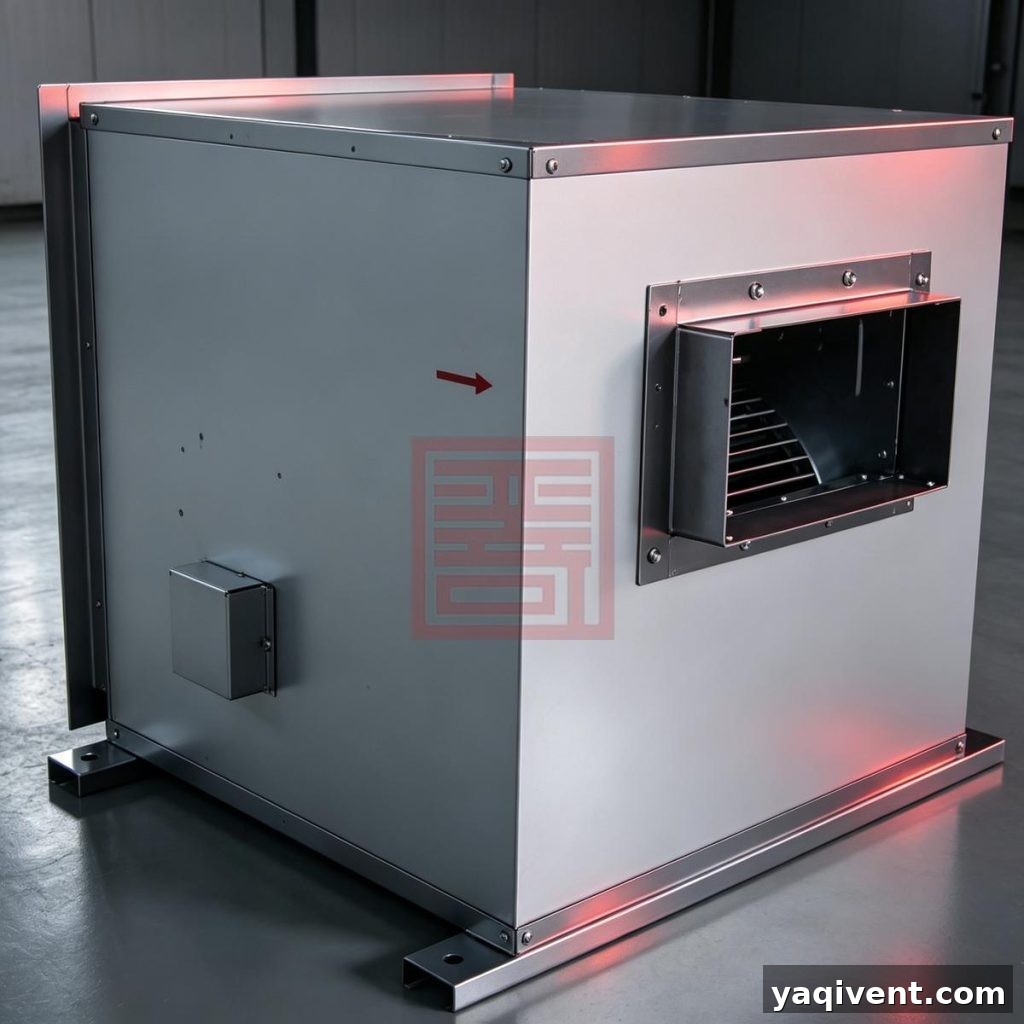
Axial and centrifugal fans both move air, but they create pressure in different ways. The right choice depends on the required airflow, system resistance, available space, temperature, noise target and maintenance plan.
This guide gives a practical comparison for HVAC and industrial project buyers.
If the application is specifically for smoke exhaust, continue with How to Select a Smoke Exhaust Fan.
Quick comparison
| Consideration | Axial fan | Centrifugal fan | Mixed-flow fan |
|---|---|---|---|
| Airflow direction | Along the fan shaft | Turns from inlet to outlet through the impeller | Between axial and centrifugal behaviour |
| Typical strength | High airflow with a compact duct footprint | Higher pressure capability | Compact compromise |
| Sensitive to system layout | Yes | Yes | Yes |
| Common application | Wall, roof, duct and smoke exhaust | Long ducts, mechanical rooms and high-resistance systems | Ventilation projects needing medium pressure |
| Noise character | Depends on speed, blades and installation | Can be controlled with casing, speed and silencers | Depends on model and operating point |
No type is universally better. The fan must be selected against the system curve.
How axial fans work
An axial fan uses rotating blades to move air parallel to the fan shaft. It is often useful when the system needs a large air volume and the available pressure is moderate.
Benefits can include:
- Straight airflow through the unit;
- A compact installation in duct, wall or roof openings;
- A broad range of sizes and speeds;
- Suitability for smoke-exhaust designs when the exact high-temperature product is specified.
Limitations can include:
- Higher sensitivity to downstream obstructions;
- Noise and vibration at inappropriate operating points;
- Limited pressure capability compared with many centrifugal designs.
View Axial Flow Ventilation Fan · View T35-11 Axial Fan · View Smoke Exhaust Axial Fan
How centrifugal fans work
A centrifugal fan draws air into the centre of an impeller and accelerates it outward into a casing. The casing converts velocity into pressure before the air leaves the outlet.
Centrifugal fans are often considered when:
- Duct systems have higher resistance;
- Air must travel through long or complex routes;
- The equipment room can accommodate the fan casing;
- A defined discharge direction is useful;
- A cabinet-type arrangement is required.
Limitations can include:
- Larger physical footprint;
- Different maintenance access needs;
- Higher sensitivity to incorrect inlet or outlet connections.
View Cabinet Centrifugal Fan · View Cabinet Smoke Exhaust Fan
Where mixed-flow fans fit
Mixed-flow fans combine features of axial and centrifugal airflow. They can provide a compact option with useful pressure capability, but they do not remove the need to check the actual performance point.
Start with the system, not the product photo
Four values should be confirmed before comparing fan types:
- Design airflow. The required air volume in m³/h, CFM or the project's standard unit.
- System pressure. Static or total pressure, including ducts, fittings, dampers, filters and outlets.
- Operating condition. Normal ventilation, smoke exhaust, high temperature, corrosive air or hazardous duty.
- Installation constraints. Available space, orientation, access, weather exposure and mounting method.
If the project provides only airflow, the supplier cannot confidently determine whether an axial or centrifugal fan will meet the system resistance.
Why higher pressure changes the fan choice
A duct system does not have a fixed resistance. Pressure loss rises as airflow increases. A fan's performance also changes with speed and system resistance.
The practical operating point is where the selected fan curve meets the system curve. A fan that produces the required airflow at free delivery may fail to deliver the same airflow after filters, dampers, elbows and long ducts are connected.
Ask for the complete operating point:
- Airflow;
- Static or total pressure;
- Speed;
- Shaft power;
- Motor power;
- Efficiency or power consumption;
- Sound data;
- Dimensions and weight.
Account for temperature and motor cooling
High-temperature smoke exhaust changes the fan construction. Motors, bearings, lubrication, clearances, wiring and cooling must be suitable for the declared duty.
For normal ventilation, high ambient temperature in a mechanical room can also reduce motor life. Confirm the motor's actual ambient rating rather than using the duct-air temperature alone.
Compare noise at the real duty
Sound data should be tied to a specific airflow, pressure and speed. A generic low-noise statement is not enough for a project sound limit.
Consider:
- Fan sound power;
- Casing radiated noise;
- Duct-borne noise;
- Silencer selection;
- Vibration isolation;
- Distance to the occupied space;
- Background noise at commissioning.
Do not ignore installation effects
Fan performance changes when the inlet or outlet is restricted. Tight bends, sudden reductions, poor roof discharge, blocked grilles and unsupported flexible connections can create additional pressure loss and turbulence.
Review the layout with the fan supplier and the duct designer, especially for compact mechanical rooms.
Selection checklist
Send these items for a quotation:
- Project country and required standard;
- Fan application and operating mode;
- Airflow and pressure;
- System drawing or fan schedule;
- Normal and emergency temperature;
- Indoor or outdoor installation;
- Horizontal, vertical or roof mounting;
- Available space;
- Power supply and control method;
- Noise and vibration limits;
- Required accessories and documentation;
- Quantity and delivery date.
Try the online fan selector
The YAQIVENT Fan Selection Center compares centrifugal, HTF axial, SWF mixed-flow and SZF axial options using airflow, pressure and motor power. It helps narrow the range before a project-specific review.
Frequently asked questions
Are axial fans better for high airflow?
They are often a compact choice for high airflow at moderate pressure, but the actual fan duty and installation must be checked.
Do centrifugal fans always provide more pressure?
Centrifugal designs are generally better suited to higher-resistance systems, but model, speed, impeller and system curve determine the actual result.
Can one fan type handle both ventilation and smoke exhaust?
Some products are designed for dual duty. Confirm the exact temperature and duration, motor cooling, controls, test documentation and project approval.
Which fan is quieter?
There is no universal answer. Compare sound data at the same operating point and account for casing, duct path, silencers and installation.
Request a fan comparison
Send the airflow, static pressure, installation location and operating temperature. YAQIVENT can compare axial, centrifugal and mixed-flow products against the enquiry.