
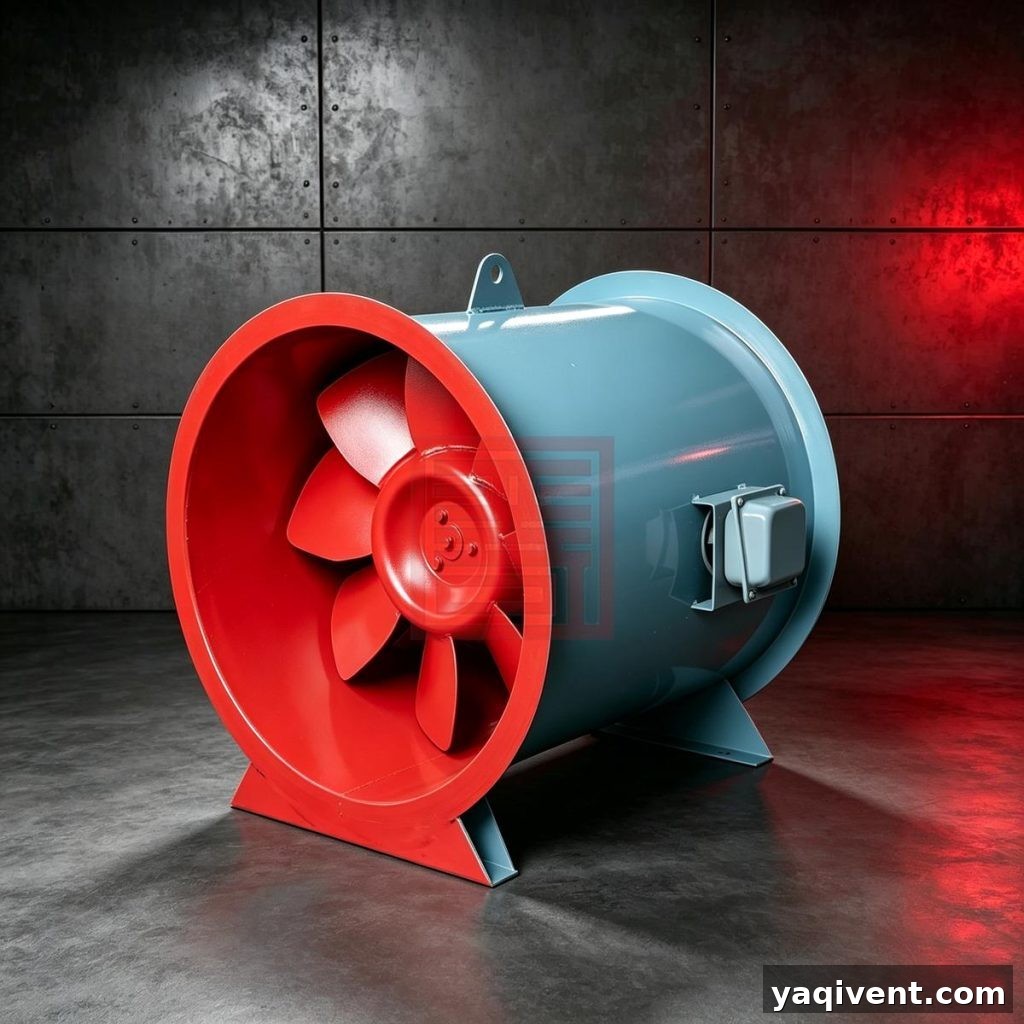
Smoke exhaust fan selection starts with the approved smoke-control design, not with a catalogue photo or a single airflow figure. The fan must move the required air volume against the actual duct-system resistance while operating under the temperature, control and maintenance conditions expected for the project.
This guide explains the information an HVAC contractor or equipment buyer should collect before requesting a smoke exhaust fan quotation.
Final selection must follow the project's approved fire strategy, local code, authority requirements and engineer's specification.
The six inputs that matter first
Before comparing models, confirm these six values:
| Input | Why it matters |
|---|---|
| Required exhaust airflow | Determines the basic air volume the fan must handle |
| System static pressure | Accounts for ducts, fittings, dampers, outlets and other resistance |
| Installation location | Affects horizontal or roof-mounted construction, access and weather protection |
| Gas temperature and duration | Determines the required high-temperature fan configuration |
| Power supply and control | Defines single-speed, two-speed or variable-frequency operation |
| Noise and vibration limits | Affects fan speed, casing, silencers and mounting details |
A fan selected only by airflow can miss the required operating point. A fan selected only by motor power can be inefficient or unable to deliver the design flow through the actual duct system.
Understand the smoke-exhaust fan duty
A smoke exhaust fan may operate in normal ventilation mode, emergency smoke-exhaust mode, or both. The enquiry should clearly state which role the fan performs.
Important questions include:
- Is the fan normally running or normally stopped?
- What airflow and pressure are required in each mode?
- What high-temperature condition must the fan withstand?
- Is a two-speed or variable-frequency drive required?
- What happens when a smoke-fire damper closes?
- Does the fire-control system need fan status, fault or remote-control signals?
The fan, damper, control panel and fire alarm sequence must be designed as one system.
Compare axial, cabinet centrifugal and mixed-flow fans
For a broader comparison of fan constructions and pressure ranges, see Axial vs Centrifugal Fan.
Axial smoke exhaust fans
Axial fans move air along the fan axis. They are often suitable for high airflow at lower to medium pressure and can fit compact duct or wall openings. High-temperature axial fans require a suitable motor, cooling arrangement and bearing system.
YAQIVENT's HTF smoke exhaust axial fan product information states continuous operation at 100°C for 20 hours and high-temperature operation at 300°C for 60 minutes, based on its stated test reference. For a real project, confirm that the exact model and documentation meet the required duty.
Cabinet centrifugal smoke exhaust fans
Cabinet centrifugal fans use a centrifugal impeller inside a compact cabinet. They are useful where the system needs higher static pressure and controlled sound within a defined equipment footprint.
They can suit long duct routes and mechanical rooms where horizontal installation and service access are planned. The enclosure, motor cooling, access doors, vibration isolation and condensate or drainage requirements should be confirmed.
View Cabinet-Type Smoke Exhaust Fan
Mixed-flow fans
Mixed-flow fans combine axial and centrifugal airflow characteristics. They can provide a compact solution between a simple axial fan and a higher-pressure centrifugal fan, but the final choice depends on the actual system curve.
Read the fan performance point, not just one number
A fan performance table usually links airflow, static pressure, speed, power and sometimes sound. The required operating point is the intersection of the fan's performance and the duct-system resistance.
Ask for:
- Airflow in m³/h or the unit used by the project;
- Static or total pressure in Pa;
- Fan speed in rpm;
- Shaft power and motor power;
- Supply voltage and frequency;
- Sound data at the relevant operating point;
- Weight and dimensions;
- Accessory and control information.
Do not compare two fans using different pressure definitions without checking the basis. If the engineer uses total pressure, do not quote a fan using static pressure as if the values were interchangeable.
Check high-temperature construction
Smoke exhaust applications can expose the fan to temperatures above normal ventilation conditions. Review:
- Motor insulation and cooling method;
- Bearing lubrication and clearance;
- Impeller material and balancing;
- Casing construction and thermal movement;
- Wiring and terminal protection;
- Test or certification documents for the declared duty.
The required temperature and duration must come from the approved design. The product must be matched to that requirement rather than selected from a generic "fire fan" label.
Confirm the control sequence
A smoke exhaust fan may need to start on a fire signal, run at a defined speed, monitor status and stop when the smoke-fire damper closes. Confirm:
- Control voltage and starting method;
- Direct-on-line, star-delta, soft-start or variable-frequency drive;
- Number of speeds;
- Remote start and stop signals;
- Running, fault and overload feedback;
- Fire-control interface;
- Damper interlock;
- Power failure or backup requirements.
If the fan is supplied with a control panel, the panel responsibility should be clear. If not, the site contractor needs the correct wiring diagram and interface information.
Review noise, vibration and service access
Noise limits should be stated as a sound pressure level at a defined location or as sound power data, not only as "low noise." Mechanical-room location, duct layout and silencer selection affect what the building receives.
Also confirm:
- Vibration-isolation type;
- Flexible connection requirements;
- Base or spring mounting;
- Maintenance space;
- Impeller inspection access;
- Motor removal route;
- Roof-mounted weather protection;
- Lifting points and shipping weight.
Procurement checklist
Send the following with an enquiry:
- Project country and applicable standard.
- Smoke-control system description.
- Required airflow and pressure in each operating mode.
- Gas temperature and duration.
- Installation orientation and indoor or outdoor location.
- Power supply, control voltage and starting method.
- Required speed control and feedback signals.
- Noise or vibration limits.
- Accessories, control panel and spare-parts scope.
- Quantity, delivery schedule and approved drawing or schedule.
Use the online selector as a starting point
The YAQIVENT Fan Selection Center lets users enter airflow, pressure and motor power, compare candidate models and view dimensions and 3D cutaways.
Use the selector to identify a starting model, then send the project conditions and control requirements for engineering review. A website result should not replace the approved system design, submittal review or local compliance check.
Frequently asked questions
What is the most important selection input?
The required airflow and pressure must be considered together, followed by temperature and control requirements. No single value is sufficient.
Should I add a safety margin?
Margins affect airflow, pressure, motor load and noise. They should be defined by the designer or based on the project's commissioning and calculation practice rather than added arbitrarily by the supplier.
Can a standard ventilation fan be used for smoke exhaust?
Only when the exact application, temperature, duration, controls and approvals are confirmed. A standard fan's normal operating temperature does not establish a smoke-exhaust rating.
What information is needed for a quotation?
Send the required airflow, static or total pressure, temperature, installation location, power supply, control method, accessories, quantity, project country and applicable standard.
Request a smoke exhaust fan review
Share the fan schedule, duct drawing and smoke-control sequence with YAQIVENT. The team can compare axial, cabinet centrifugal and mixed-flow options against the enquiry.