
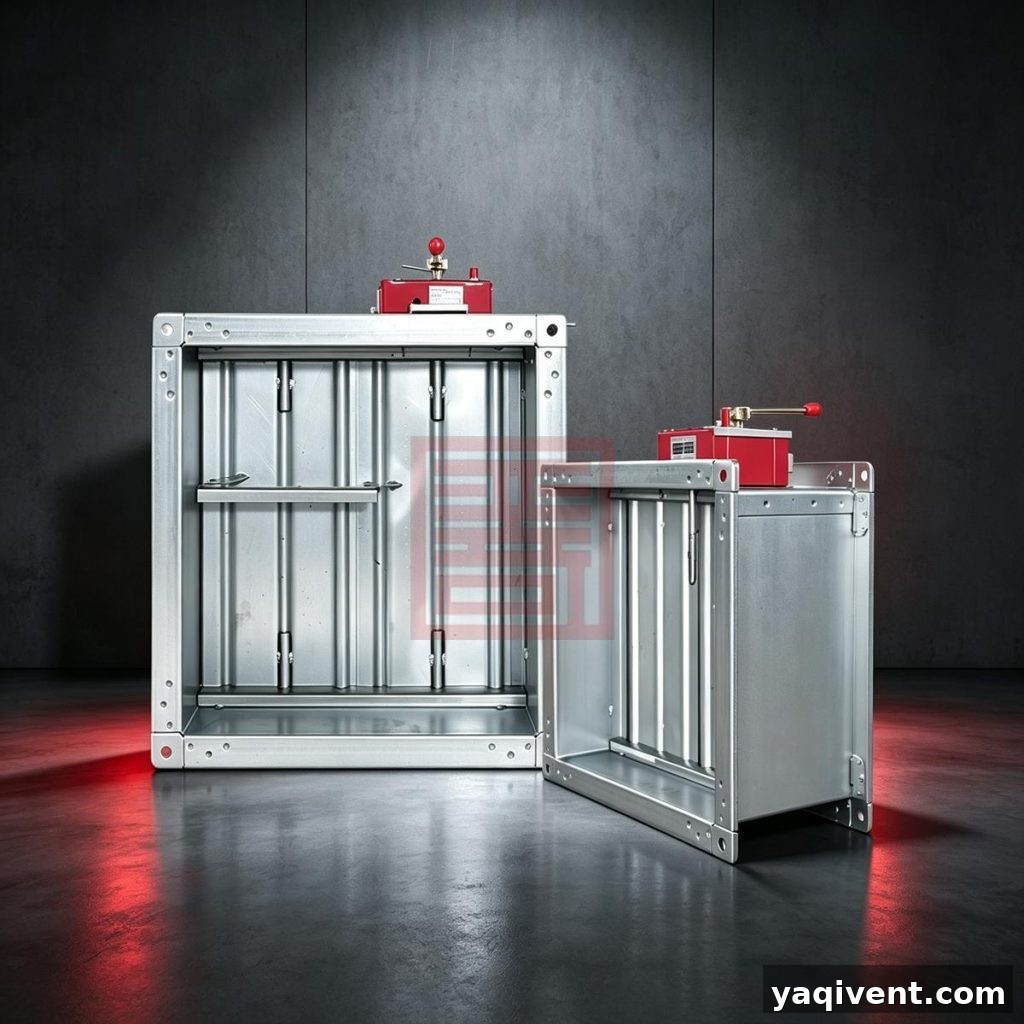
A damper is a controlled obstruction inside an air duct. Different dampers may look similar from the outside, but their function can be completely different: stopping fire spread, supporting smoke extraction, balancing airflow, preventing backflow or relieving excess pressure.
This guide explains the main HVAC damper types and the information needed to select the right one.
For a detailed comparison of 70°C and 280°C fire and smoke dampers, see Fire Damper vs Smoke Fire Damper.
The final product must match the approved HVAC or fire strategy, applicable code and engineer's specification.
Quick comparison
| Damper type | Main function | Typical location | Common operation |
|---|---|---|---|
| Fire damper | Limit fire spread through a duct crossing a protected boundary | Supply, return or exhaust duct at a fire separation | Usually open; closes on thermal release |
| Smoke-fire damper | Support smoke exhaust and isolate the duct at high temperature | Mechanical smoke-exhaust duct | Usually open; closes at its rated temperature |
| Manual volume damper | Balance airflow | Supply or return branch duct | Manually adjusted and locked |
| Motorized volume damper | Automatically regulate or isolate airflow | Duct connected to a control system | Actuator controlled remotely |
| Non-return damper | Prevent reverse airflow | Fan discharge or duct with possible backflow | Opens with flow and closes when flow reverses |
| Pressure-relief damper | Relieve excess pressure | Protected room, stairwell or duct system | Opens when pressure exceeds the setting |
Fire dampers
Fire dampers are installed where a duct crosses a fire-resisting wall, floor or other protected boundary. The blades normally remain open so the ventilation system can operate.
A thermal release, commonly around 70°C for a standard fire damper, allows the damper to close and limit the movement of fire and hot gases through the duct.
Selection questions:
- What fire-resistance period and tested installation method are specified?
- Is the duct horizontal or vertical?
- What size and flange arrangement are required?
- Is position feedback or motorized operation needed?
- Is an access panel required for inspection and reset?
Smoke-fire dampers
Smoke-fire dampers are associated with mechanical smoke-exhaust ducts. The damper normally remains open and allows the exhaust system to extract smoke.
When the gas temperature reaches the rated release point, commonly 280°C in this product category, the damper closes to isolate the duct penetration. The closing signal may also be used in the smoke-exhaust fan control sequence.
Selection questions:
- Is the damper on a main duct, branch duct or shaft connection?
- What smoke-exhaust temperature and duration apply?
- Is the damper normally open?
- Is position feedback required?
- Does the fan need to stop when the damper closes?
- Is remote motorized closing required?
Manual volume control dampers
Manual volume dampers regulate airflow in a duct branch. The balancing contractor adjusts the blades and locks the position after measuring the system.
They are common in supply and return systems where commissioning requires local airflow adjustment. Selection should consider blade arrangement, frame material, locking mechanism, access and leakage requirements.
Motorized volume dampers
Motorized dampers use an electric actuator to open, close or modulate airflow. They are used when a building-management system, fire-control system or process controller needs remote operation.
Confirm:
- AC or DC actuator voltage;
- On/off, spring-return or modulating operation;
- Required torque;
- Position feedback;
- Fail-safe position on power loss;
- Control signal and wiring diagram.
Non-return dampers
A non-return damper allows air to move in one direction and closes when flow reverses. It can protect a fan from backflow or prevent air from moving through an inactive branch.
The low-pressure opening behaviour, blade arrangement, installation orientation and spring or gravity return should be reviewed against the duct velocity and required pressure loss.
Pressure-relief dampers
Pressure-relief dampers open when the pressure difference exceeds a set value. They can protect a room or duct system from excessive pressure while maintaining the intended airflow direction.
Ask for the required opening pressure, allowable leakage, adjustment method and installation orientation. A general-purpose volume damper is not necessarily a calibrated relief device.
What to include in the damper schedule
A useful schedule should identify:
- System and damper type;
- Required function;
- Duct width and height, or diameter;
- Installation orientation;
- Design airflow;
- Maximum pressure difference;
- Required release temperature;
- Manual, motorized or feedback options;
- Actuator voltage and control signal;
- Frame and blade material;
- Access and inspection requirements;
- Project standard and quantity.
Common selection mistakes
Treating every damper as a volume damper
Fire, smoke and pressure-control dampers perform safety functions. They should not be substituted with a generic airflow damper.
Selecting only by duct size
Two dampers with the same dimensions can have different blades, seals, actuators and release temperatures.
Forgetting the control interface
A motorized damper that cannot communicate with the building control system may fail commissioning even if the mechanical product is correct.
Ignoring access
Inspection and reset require safe access. Confirm the installation and maintenance plan before production.
Request damper selection support
Send the damper schedule, duct drawing, project country, required standard and control details. YAQIVENT can help match fire, smoke, volume, non-return and pressure-relief products to the enquiry.