
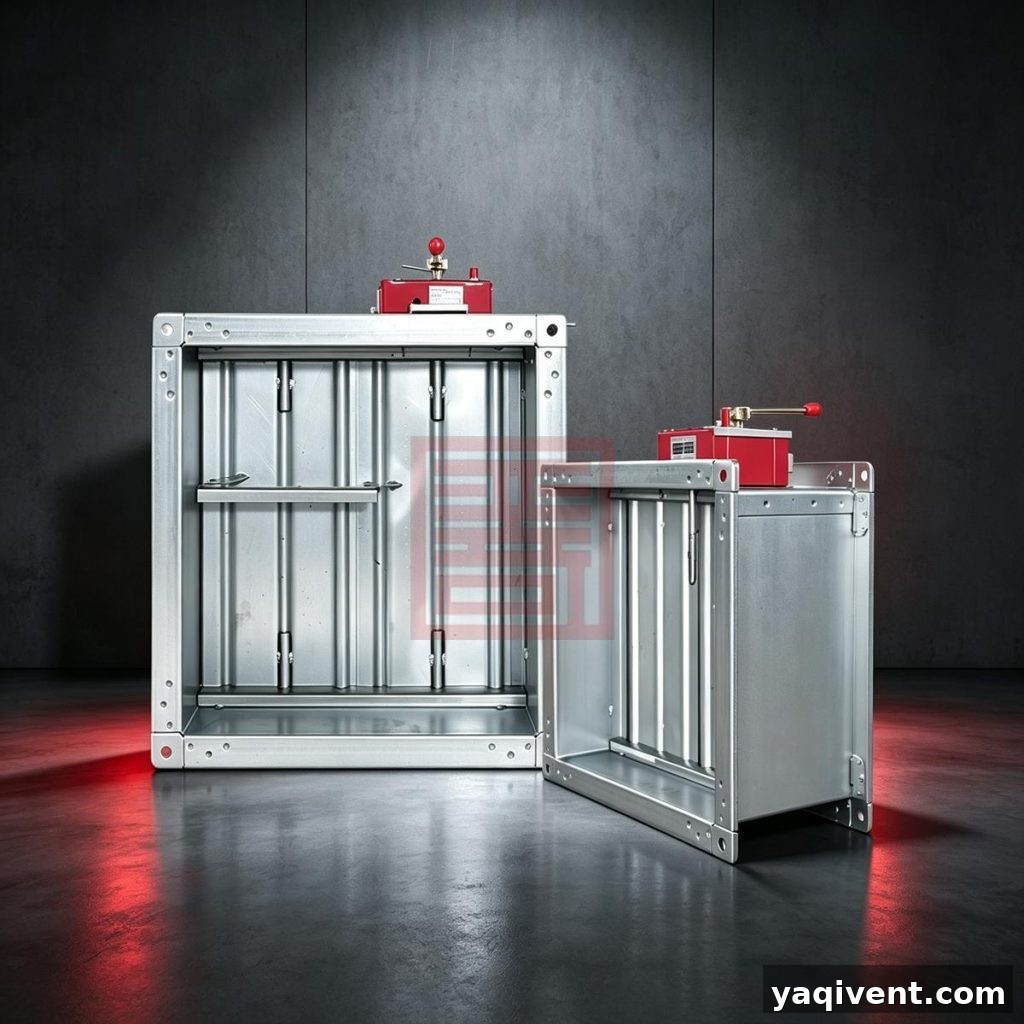
A fire damper and a smoke-fire damper may look similar, but they perform different jobs in a building's ventilation and smoke-control system. The most important difference is not the shape of the damper. It is where the damper is installed, what the duct system is designed to do during a fire, and the temperature at which the damper is intended to close.
This guide compares two common configurations: a fire damper with a 70°C fusible link and a smoke-fire damper with a 280°C thermal release. It also lists the information an HVAC contractor or project buyer should confirm before placing an order.
For the wider range of volume, non-return and pressure-control products, see HVAC Damper Types: Fire, Smoke, Volume and Relief.
Final product selection must follow the project's approved fire strategy, local code, authority requirements and engineer's specification. The descriptions below are a practical comparison, not a substitute for project-specific approval.
Fire damper and smoke-fire damper at a glance
| Item | Fire damper, typically 70°C | Smoke-fire damper, typically 280°C |
|---|---|---|
| Main purpose | Limit fire spread through an HVAC duct that crosses a fire separation | Support smoke exhaust and isolate the smoke-exhaust duct when flue-gas temperature becomes excessive |
| Typical system | Normal ventilation, supply or return ductwork | Mechanical smoke-exhaust system |
| Normal blade position | Usually open | Usually open |
| Closing trigger | Fusible link reaches its rated temperature, commonly 70°C | Fusible link reaches its rated temperature, commonly 280°C |
| Common controls | Manual reset; optional signal feedback or motorized operation | Manual reset; optional position feedback or DC24V motorized closing |
| Key selection input | Duct size, installation location, required fire rating and local approval | Smoke-exhaust design, gas temperature, duct size, control sequence and fan interlock |
| Typical question to ask | Does this location require a fire damper, and which tested configuration is approved? | What smoke-control sequence, feedback signal and fan interlock does the project require? |
The values 70°C and 280°C are common reference points. They should not be treated as interchangeable labels or as the only criterion for selecting a product.
What a 70°C fire damper does
A fire damper is installed where an HVAC duct passes through a fire-resisting wall, floor or other protected boundary. In normal operation, the blades stay open so air can move through the duct.
When the fusible link reaches approximately 70°C, the release mechanism operates and the blades close. The damper then helps prevent fire and hot gases from using the duct as a path across the protected boundary.
For procurement, the word “approximately” matters. Confirm the actual release temperature and tested product configuration from the manufacturer's documentation and the project specification. Do not assume that every 70°C damper has the same body, blade, seal, actuator or approval.
Questions for a 70°C fire damper
- Is the duct a normal HVAC supply or return duct, or part of a smoke-control system?
- Is the damper installed in a vertical or horizontal duct?
- What is the required fire-resistance period and approved installation method?
- Does the project require a manual access panel or inspection opening?
- Is position feedback required for the fire alarm or building-management system?
- Does the project prefer a manual reset or a motorized actuator?
What a 280°C smoke-fire damper does
A smoke-fire damper is normally used in a mechanical smoke-exhaust duct system. Under normal conditions, the damper remains open and allows the exhaust system to operate.
During a fire, the fan may extract hot smoke through the duct. The damper is designed to remain operational through the smoke-exhaust period and close when the temperature reaches its rated release point, commonly 280°C. Closing can protect the duct penetration and may be linked to the smoke-exhaust fan control sequence.
That sequence should be defined by the fire strategy. A damper that closes too early or at the wrong time may conflict with the intended smoke extraction. This is why the product, actuator and control logic must be reviewed together.
Questions for a 280°C smoke-fire damper
- Is the damper on a main smoke-exhaust duct, a branch duct or a shaft connection?
- What is the specified smoke-exhaust temperature and duration?
- Is the damper normally open, and what is the approved reset procedure?
- Does the fire-control system require an open/closed position signal?
- Does the fan need to stop when the damper closes?
- Is the installation location accessible for inspection, testing and reset?
- Is a rectangular or circular damper required?
Why the temperature difference matters
A 70°C release is associated with shutting off a duct penetration during an ordinary fire condition. A 280°C release is associated with a smoke-exhaust duct that may need to keep extracting smoke while the gas temperature rises.
The higher number does not mean the product is universally “better.” It means the intended system and operating condition are different. Using a 280°C smoke-fire damper where a tested 70°C fire damper is specified can create an approval problem, and using the wrong product in a smoke-exhaust system can interfere with the smoke-control strategy.
The correct question is therefore:
What function must this damper perform in the approved system, and which tested configuration is specified for this exact location?
Selection checklist before requesting a quotation
Send the manufacturer or supplier a complete requirement rather than only a product name. A useful enquiry includes:
- Project country and applicable standard or specification
- Duct system: normal ventilation, smoke exhaust or combined function
- Damper type and required release temperature
- Rectangular or circular duct dimensions
- Airflow direction and installation orientation
- Required blade position in normal operation
- Manual or motorized operation
- Required voltage and control signal, if motorized
- Position feedback and fan-interlock requirements
- Frame and blade material
- Access, inspection and reset requirements
- Quantity and required delivery date
- Relevant drawings, schedules or approved material submittal
For custom projects, a marked-up duct drawing is often more useful than a short message such as “send price for fire damper.” It allows the supplier to identify the location, size and control requirements before quoting.
Documentation to request with the quotation
The exact document package depends on the market, but a project buyer should normally ask for:
- Product drawing with dimensions and flange details
- Material specification
- Damper schedule or ordering code
- Actuator and control wiring information, when applicable
- Installation and maintenance instructions
- Test or certification documents relevant to the declared market
- Packing information for export shipment
Do not accept a certificate as proof that the exact model and installation method are approved unless the certificate clearly covers them. Match model, size, release temperature, actuator and intended use.
Common procurement mistakes
Comparing only the temperature
Two dampers may both be described as “fire dampers,” yet have different blade arrangements, seals, actuators, frames and approved installation methods. Compare the complete configuration.
Forgetting the control sequence
For smoke-control projects, the damper is part of a sequence involving detectors, fans, control panels and power supplies. A low product price can be offset by commissioning problems if the feedback and interlock requirements were not defined.
Ordering before checking the opening
Duct dimensions, flange holes, wall thickness and installation orientation affect the product and the installation. Confirm them before production.
Ignoring access
Manual reset, inspection and testing require access. A damper that cannot be reached may create a maintenance problem after handover.
Treating “equivalent” as identical
An alternative product should be reviewed against the approved submittal, not only against a similar product photo. Document every deviation.
Selection example
Consider a commercial building with two duct locations:
- A supply-air duct crosses a protected wall. The engineer specifies a fire damper with thermal release at the boundary.
- A mechanical smoke-exhaust duct passes through a shaft connection. The engineer requires a normally open smoke-fire damper, position feedback and an interlock with the exhaust fan.
Although both locations need a damper, they do not need the same function. The first protects a fire separation during a fire. The second supports smoke extraction and must close only according to the approved control sequence.
The supplier should therefore receive two separate line items with different release temperatures, control requirements and installation details.
Products to compare
YAQIVENT supplies rectangular and circular fire, smoke and volume-control dampers with project-specific options. Share the duct schedule, installation location, required standard and quantity to receive selection support.
Frequently asked questions
Is a smoke-fire damper the same as a smoke damper?
Terminology varies by market and standard. In this article, “smoke-fire damper” refers to a damper used in a smoke-exhaust duct with a high-temperature release, commonly 280°C. Always match the project terminology to the approved product definition and local code.
Can a 280°C damper replace a 70°C fire damper?
Do not make that substitution without written approval from the designer and authority. The intended function, tested configuration and installation method must match the specification.
Should the damper be normally open or normally closed?
It depends on the system and fire strategy. Fire and smoke-exhaust dampers in many duct systems are normally open, while other smoke-control devices may be configured differently. Confirm the approved sequence rather than choosing a default.
Why is position feedback requested?
Position feedback lets the fire-control or building-management system monitor whether the damper has reached the required position. The project engineer should define whether a simple open/closed signal, remote control or fan interlock is required.
What information is needed for a quotation?
Provide the project country, damper type, release temperature, duct dimensions, installation orientation, control voltage, feedback requirements, material, quantity and relevant drawings or standards.
Request a project review
Send your damper schedule or marked-up duct drawing with the project country and required standard. The YAQIVENT team can help match the damper configuration, actuator and feedback options to the enquiry before you finalize the order.