
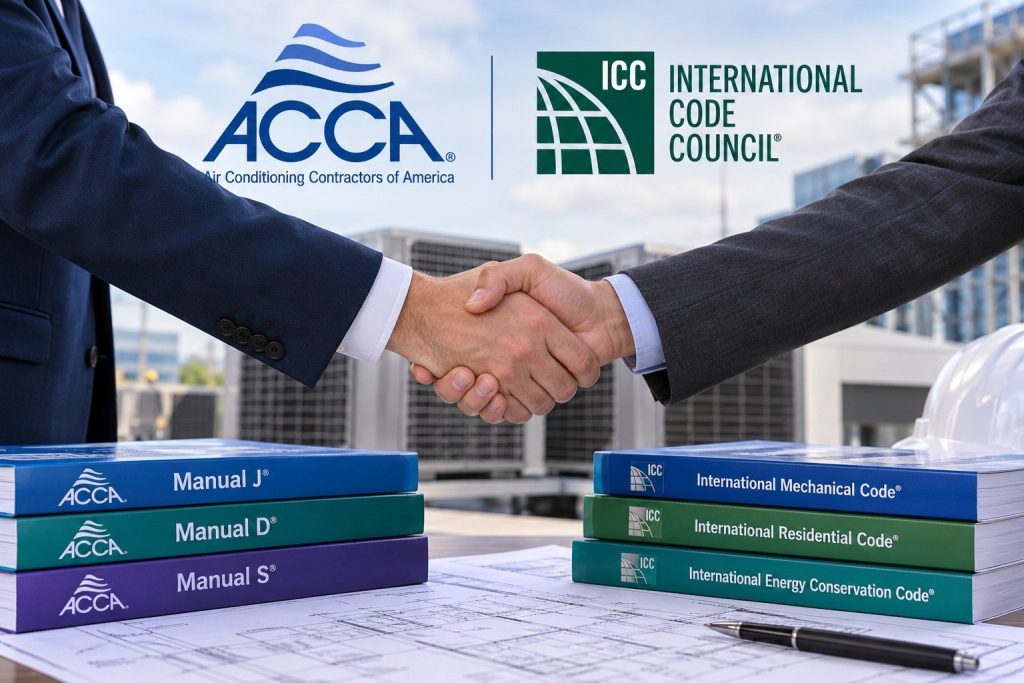
Source: Refindustry, “ACCA and ICC Expand US Alliance on HVACR Codes and Standards” (October 2026) — refindustry.com
The Air Conditioning Contractors of America (ACCA) and the International Code Council (ICC) announced an expanded alliance on 22 October 2026, setting a new framework for cooperation on HVACR codes, standards, education and industry issues. The two organisations have worked together since 2009; the agreement renews and upgrades that relationship.
Under the agreement the two will support bringing ACCA’s Manual J, Manual D and Manual S design standards into the International Codes — the International Mechanical Code, International Residential Code and International Energy Conservation Code — and will take part in each other’s code and standards development processes, aiming for requirements that are practical, enforceable and technically sound.
On education, they plan joint programmes, webinars and seminars for contractors and code officials covering code compliance, HVACR design and installation practice, and will examine aligning ICC certification programmes with ACCA training curricula.
The alliance also covers awareness work on permitted work and professional design, including the risks of unlicensed installation. The organisations will exchange research, data and technical insight on emerging technologies, including low-GWP refrigerants and heat pump adoption.
Martin Hoover, ACCA’s interim president and CEO, said: “ACCA contractors work with building codes every day, so it is critical that the codes and standards governing HVACR systems are practical, technically sound, and enforceable in the field. This agreement strengthens our longstanding relationship with ICC and creates new opportunities to bring the experience of contractors and code officials together.”
YAQIVENT’s view
The significance for the US market is that Manual J/D/S move from industry practice into the I-Codes: load calculation, duct design and equipment selection will increasingly be checked as code requirements. For Chinese exporters that is both a barrier and an opening — suppliers who can provide selection data, airflow and static-pressure curves, noise and efficiency evidence in the US format will find it easier to be accepted by local contractors.
Three practical steps: prepare product data in a form Manual S/J can cite directly; map products against the relevant IMC/IECC clauses (ventilation rates, insulation, fire safety); and build training partnerships with local distributors and contractors so code-compliant selection becomes a sales tool. Certifications and documents done in advance are far cheaper than scrambling on a project.
Source: Refindustry (refindustry.com). This is an industry summary; the commentary section is YAQIVENT’s own analysis.